How Twitch Became Unbearable to Watch
From Justin.tv and all-day StarCraft II to parasocial spending, manufactured outrage, and Monster Hunter damage meters: how Twitch stopped feeling like a place to hang out.
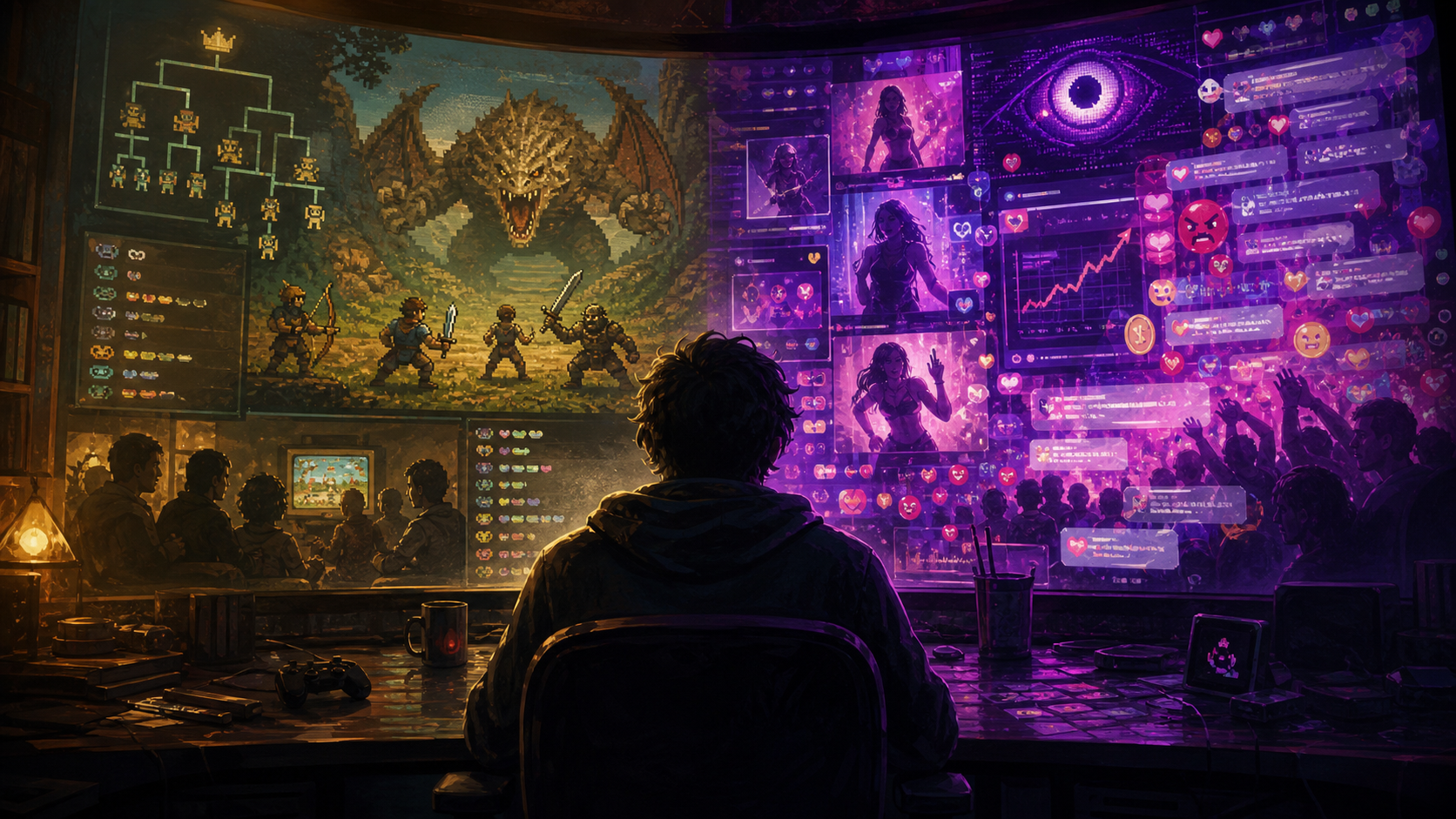
I have been on Twitch since before it was Twitch - back when it was still Justin.tv.
The platform was never perfect. There were always obnoxious streamers, toxic communities, and people desperate for attention. But beneath all that, Twitch used to feel like a place where you could simply hang out. You watched somebody play a game, talked with familiar names in chat, and gradually became part of a small community.
I remember watching StarCraft II tournaments from morning until night. During the COVID lockdowns, I streamed Monster Hunter Generations Ultimate constantly. I found new hunting friends, joined ridiculous hunts, and had more fun than I knew what to do with.
Those memories are why modern Twitch disappoints me so much.
The website still looks roughly the same, but the culture underneath it has changed. What was once a collection of gaming communities increasingly feels like a marketplace built around attention, emotional dependency, outrage, and desperation.
From hanging out to performing constantly
Older Twitch streams often felt casual. Not every quiet moment had to become content. A streamer could concentrate on the game while chat talked among itself. Nobody seemed terrified that ten seconds of silence would destroy their career.
Today, many streams feel like permanent performances.
Every reaction must be exaggerated. Every disagreement must become drama. Every ordinary moment must have the potential to become a clip. Twitch itself introduced a personalized, scrollable discovery feed built around clips, further pushing livestreaming toward the short-form attention economy. That does not force anyone to behave badly, but it rewards moments that can grab a stranger immediately: anger, humiliation, sexual provocation, conflict, or theatrical overreaction. Twitch’s Discovery Feed announcement
The result is a platform that increasingly resembles reality television with a chat box.
Gaming is still there, but it often feels secondary to the personality cult surrounding the person playing it.
The monetization of friendship
Twitch sells more than entertainment. It sells proximity.
Viewers can subscribe, gift subscriptions, cheer with Bits, send donations, unlock badges, and pay to have a message noticed. Twitch describes subscriptions as a way to support a channel, while its monetization system ties creator income to subscriptions, advertisements, and viewer spending. Twitch Creator Camp · Twitch Partner program
There is nothing inherently wrong with supporting an entertainer. Livestreaming costs time and money, and good creators deserve to be paid.
The problem begins when financial support becomes entangled with simulated friendship.
Research into livestream audiences has found that stronger parasocial attachment can predict whether viewers send virtual gifts or donations. The feeling of knowing a streamer - even though the relationship is fundamentally unequal - can become part of the business model. Kneisel and Sternadori’s study in Convergence
That incentive changes both sides of the relationship.
The streamer must make viewers feel personally important enough to keep returning and paying. The viewer may begin treating money as a route to recognition, belonging, or intimacy. Donations become messages. Gift subscriptions become public demonstrations of loyalty. Being remembered by the streamer starts to feel like social status.
For some viewers, especially lonely ones, this can become a substitute for mutual friendship. They tolerate ridicule, insults, or being dismissed as “normies” because leaving would mean losing the community around which they have organized their evenings.
The tragedy is that the belonging can feel real even when the relationship producing it is commercial.
The dream that everybody will “make it”
Twitch also suffers from the same fantasy consuming the wider creator economy: the belief that anyone can escape ordinary employment if they grind hard enough.
Too many people behave as if becoming a successful streamer is inevitable rather than extraordinarily unlikely. They stream for punishing hours, measure every new follower, and treat normal employment as personal failure. Playing games becomes “the grind,” and every conversation eventually returns to growth, numbers, subscriptions, or how unfair the algorithm is.
The insecurity is real. Research on Twitch has described streaming as a form of precarious labour requiring continuous performance, emotional work, and constant connection. Creators appear independent, but their income and visibility remain dependent on a platform they do not control. The Affective Labor and Performance of Live Streaming on Twitch.tv
That precarity helps explain the constant begging.
When your income changes every month, a quiet stream is not merely boring - it is financially frightening. A departing subscriber becomes a tiny pay cut. Taking time off risks losing momentum. The creator must continually remind the audience to subscribe, gift, donate, follow, share, and remain emotionally invested.
I understand why streamers do it. The platform has placed them inside a system where attention must be converted into money before it disappears.
Understanding it does not make it pleasant to watch.
Contempt for the people paying the bills
One of the strangest parts of this culture is the contempt some streamers show toward ordinary employment.
They mock people with nine-to-five jobs. They talk about workers as “NPCs” or “normies” who failed to escape the matrix. Meanwhile, the subscriptions, Bits, and donations supporting the stream frequently come from those exact people.
There is nothing shameful about streaming for a living. It can require discipline, charisma, technical knowledge, moderation, preparation, and long working hours.
But there is also nothing shameful about having a stable job, health insurance, paid leave, or a predictable income. Playing games in front of a camera does not place somebody above the person paying to watch them.
The contradiction becomes almost comic: someone whose livelihood depends on audience generosity ridiculing that audience for having the stable employment that makes generosity possible.
And viewers accept it because the ridicule is presented as participation. Being insulted by the group still feels better than being outside the group.
Sexualization, edginess, and the race for attention
Sexualized content is not the only problem with Twitch, and blaming women for the platform’s decline would be both lazy and inaccurate.
The real problem is an attention system that encourages everyone to discover the most immediately marketable version of themselves. For some, that means sexual provocation. For others, it means rage, cruelty, gambling, humiliation, political extremism, or endless “edgy” jokes.
Even chats dedicated to ordinary games can descend into demands for nude pictures, obsessive comments about women, or jokes that become increasingly disturbing as everyone tries to outdo the previous message.
Twitch officially prohibits pornography, sexual solicitation, grooming, sexual exploitation of minors, and persistent requests for nude images. When that conduct appears, it is not simply “dark humour”; it is conduct the platform itself tells users to report. Twitch Community Guidelines · Twitch reporting guidance
The issue is not that Twitch has no rules. It is that a platform of this scale relies on inconsistent moderation, individual channel cultures, and users being willing to report what they encounter. Something can be formally prohibited and still remain visible long enough to poison a community.
After a while, the constant boundary-pushing becomes exhausting. You no longer feel as though you are watching people enjoy games. You feel as though you are watching people test how offensive, sexual, or humiliating they can be without losing their accounts.
What happened to Monster Hunter?
Monster Hunter is the clearest example of what I feel has been lost.
Before Monster Hunter: World, the series was comparatively niche in the West. Its technical limitations were part of the experience. We organized lobbies, learned the monsters, made do with imperfect equipment, and judged hunters by watching them hunt.
You could see whether somebody understood positioning. You noticed who brought supplies, who saved another hunter with a well-timed Lifepowder, who recognized when to stop attacking, and who could turn an accident into a brilliant moment.
Not every hunt had to be optimal. Sometimes the point was to attempt something stupid and hope it produced a great clip.
World deserved its success. Capcom credited its simultaneous worldwide release and global promotion with helping the series reach a broader international audience. The PC version followed in August 2018, and by March 2024 the game had passed 25 million units including shipments of Iceborne Master Edition. Capcom's PC release announcement · Capcom's 25-million sales announcement
In the PC streams and communities I watched, that larger audience also made damage calculations, overlays, meters, optimization tools, nude mods, and MMO-style comparisons between players much more visible.
Tools are not automatically bad. Damage data can help somebody understand a weapon or improve a build. The problem begins when measurement replaces observation.
A meter cannot properly value the hunter who created openings, used support items, managed status effects, or prevented the quest from failing. Yet once a clean number exists, people begin treating it as the complete definition of skill.
The hunt stops being a cooperative encounter and becomes a spreadsheet with a monster in it.
That mentality produces players who believe they cannot fight something until they possess the perfect talisman or an “optimized” set copied from somebody else. Preparation - which has always been part of Monster Hunter - turns into paralysis. Instead of learning the monster with the equipment they have, they wait for a theoretical build to grant them permission to play.
Monster Hunter was never only about damage. It was about adaptation, commitment, knowledge, improvisation, and cooperation. Its older games could be awkward and deliberately hostile, but that friction taught players to pay attention.
If more newcomers explored the history of the series, they might understand why many longtime hunters care about more than clear times and damage percentages. They might discover the real beauty of Monster Hunter: not perfect numerical execution, but four people somehow turning chaos into a successful hunt.
Twitch did not change for one reason
It would be comforting to blame a single group, category, or generation of viewers. The reality is more complicated.
Twitch grew from a collection of relatively small communities into a giant commercial platform. Livestreaming became a plausible career, so casual play became professional performance. Monetization turned attention and emotional closeness into revenue. Discoverability increasingly rewarded moments that could circulate as clips. During 2020, Twitch reported that its daily visitors rose from 17.5 million to 26.5 million and monthly broadcasters from 4 million to 7 million as more people turned to streams for entertainment and connection. Twitch's 2020 Community Letter Meanwhile, creators faced the insecurity of trying to earn a living from an audience that could disappear at any moment.
None of these developments automatically creates a toxic community. Together, however, they reward exactly the behaviour that makes modern Twitch so exhausting:
- Never stop performing.
- Never allow silence.
- Turn relationships into retention.
- Turn loyalty into spending.
- Turn play into measurable productivity.
- Turn disagreement into content.
- Turn every boundary into something to test.
- Convince yourself - and your viewers - that success is just one more subscription away.
The platform did not simply fill up with worse people. Its incentives changed what kinds of behaviour became visible, sustainable, and profitable.
The old Twitch still exists - somewhere
There are still good communities on Twitch. Most of the spaces I enjoy now belong to older creators or smaller channels that have resisted the pressure to convert every interaction into content.
Those streams remind me why I stayed on the platform for so long. People still talk about the game. Regulars remember one another. The streamer can be quiet without panicking. Nobody needs to manufacture drama. Nobody treats the viewer like either a customer to extract money from or a loser to humiliate.
But finding those spaces has become harder.
Perhaps part of this is nostalgia. Justin.tv and early Twitch were never as innocent as memory makes them appear. I was younger, the communities were smaller, and the novelty of livestreaming made ordinary interaction feel special.
Still, nostalgia does not explain everything.
Something has been lost: the sense that watching a stream could be enough. That a game did not need to become a career, a controversy, a relationship simulator, or a numerical competition. That people could gather around a shared interest without immediately turning their attention, loneliness, and insecurity into products.
I do not miss Twitch because it was pure.
I miss it because it once felt human.
Continue the thought.
No comments yet. Be the first to share your thoughts!